Industrialization, Environmental Pollution & Endometriosis

Reviewed 13 September 2026

Download PDF

What the evidence suggests – and what is still unproven

Corrected conceptual infographic
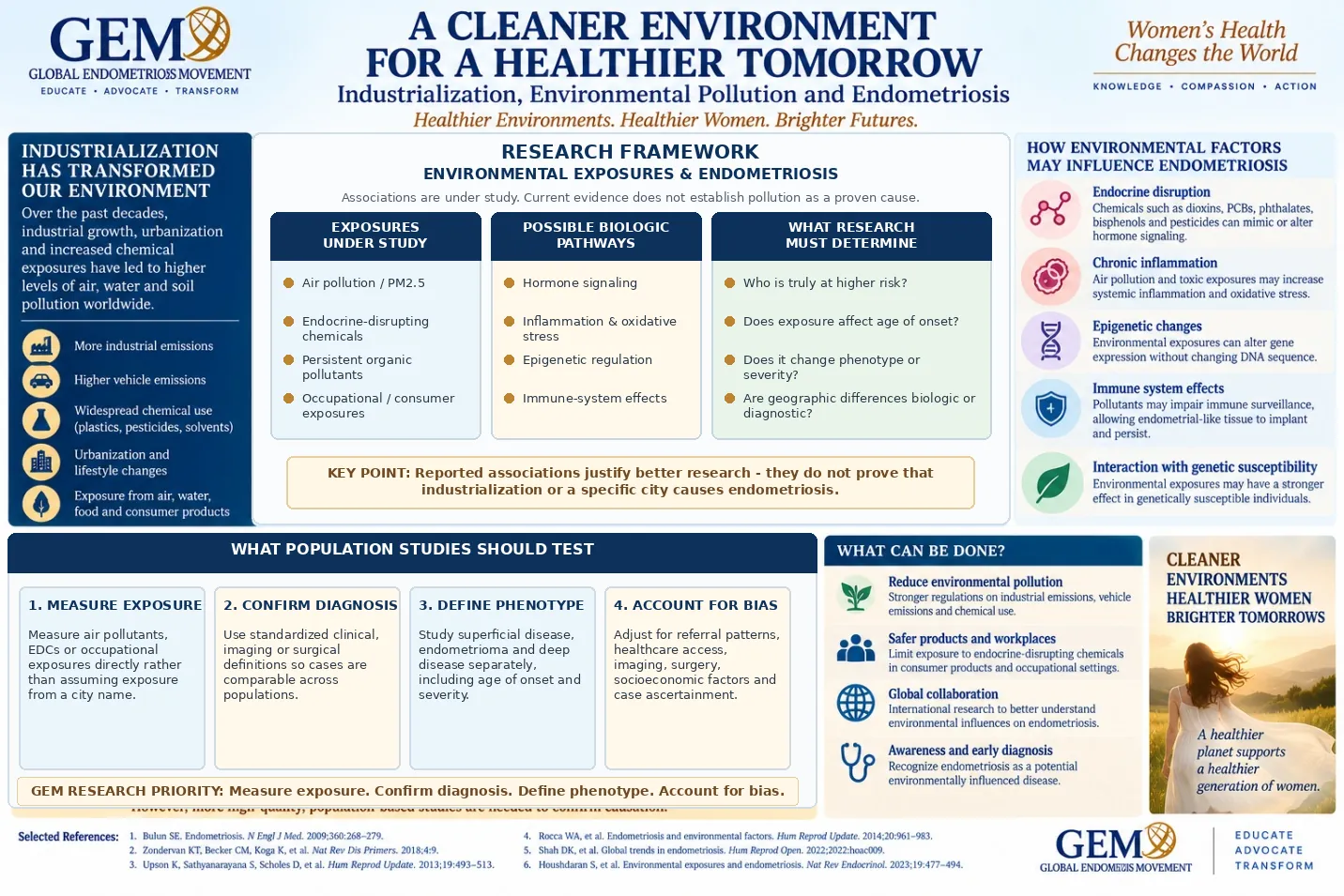
Infographic titled A Cleaner Environment for a Healthier Tomorrow – Industrialization, Environmental Pollution and Endometriosis – Healthier Environments. Healthier Women. Brighter Futures. GEM Global Endometriosis Movement logo (Educate, Advocate, Transform) and the words Women's Health Changes the World (Knowledge, Compassion, Action). Left panel: Industrialization Has Transformed Our Environment – Over the past decades, industrial growth, urbanization and increased chemical exposures have led to higher levels of air, water and soil pollution worldwide; icons for More industrial emissions, Higher vehicle emissions, Widespread chemical use (plastics, pesticides, solvents), Urbanization and lifestyle changes, Exposure from air, water, food and consumer products. Centre panel: Research Framework – Environmental Exposures & Endometriosis – Associations are under study. Current evidence does not establish pollution as a proven cause. Three columns: Exposures Under Study (Air pollution / PM2.5; Endocrine-disrupting chemicals; Persistent organic pollutants; Occupational / consumer exposures), Possible Biologic Pathways (Hormone signaling; Inflammation & oxidative stress; Epigenetic regulation; Immune-system effects), What Research Must Determine (Who is truly at higher risk? Does exposure affect age of onset? Does it change phenotype or severity? Are geographic differences biologic or diagnostic?). Key Point: Reported associations justify better research – they do not prove that industrialization or a specific city causes endometriosis. Right panel: How Environmental Factors May Influence Endometriosis – Endocrine disruption (Chemicals such as dioxins, PCBs, phthalates, bisphenols and pesticides can mimic or alter hormone signaling); Chronic inflammation (Air pollution and toxic exposures may increase systemic inflammation and oxidative stress); Epigenetic changes (Environmental exposures can alter gene expression without changing DNA sequence); Immune system effects (Pollutants may impair immune surveillance, allowing endometrial-like tissue to implant and persist); Interaction with genetic susceptibility (Environmental exposures may have a stronger effect in genetically susceptible individuals). Lower left: What Population Studies Should Test – 1. Measure Exposure (Measure air pollutants, EDCs or occupational exposures directly rather than assuming exposure from a city name); 2. Confirm Diagnosis (Use standardized clinical, imaging or surgical definitions so cases are comparable across populations); 3. Define Phenotype (Study superficial disease, endometrioma and deep disease separately, including age of onset and severity); 4. Account for Bias (Adjust for referral patterns, healthcare access, imaging, surgery, socioeconomic factors and case ascertainment). GEM Research Priority: Measure exposure. Confirm diagnosis. Define phenotype. Account for bias. Lower right: What Can Be Done? – Reduce environmental pollution (Stronger regulations on industrial emissions, vehicle emissions and chemical use); Safer products and workplaces (Limit exposure to endocrine-disrupting chemicals in consumer products and occupational settings); Global collaboration (International research to better understand environmental influences on endometriosis); Awareness and early diagnosis (Recognize endometriosis as a potential environmentally influenced disease). A photograph of a woman in a white dress standing in a sunlit field with the words Cleaner Environments, Healthier Women, Brighter Tomorrows and A healthier planet supports a healthier generation of women. Bottom strip, Selected References: 1. Bulun SE. Endometriosis. N Engl J Med. 2009;360:268-279. 2. Zondervan KT, Becker CM, Koga K, et al. Nat Rev Dis Primers. 2018;4:9. 3. Upson K, Sathyanarayana S, Scholes D, et al. Hum Reprod Update. 2013;19:493-513. 4. Rocca WA, et al. Endometriosis and environmental factors. Hum Reprod Update. 2014;20:961-983. 5. Shah DK, et al. Global trends in endometriosis. Hum Reprod Open. 2022;2022:hoac009. 6. Houshdaran S, et al. Environmental exposures and endometriosis. Nat Rev Endocrinol. 2023;19:477-494.

Open full size

Evidence & references

Industrialization, Environmental Pollution & Endometriosis
Version 1.3 · Reviewed 13 September 2026

Associations do not establish causation

Reviews report associations for selected endocrine-disrupting chemicals, but study designs, timing of exposure measurement, selection and confounding limit inference. Reviews reach differing assessments of the overall strength of evidence.

Model and reference identity

The retained image proposes research steps, not city-specific proof. Vallee et al. is a narrative review published in the 2024 issue (online 2023); Sirohi et al. is a systematic literature review in the 2021 issue (online 2020). Neither establishes an individual cause.

Full references

  • [R35667590] Coiplet E, Courbiere B, Agostini A et al. Endometriosis and environmental factors: A critical review. J Gynecol Obstet Hum Reprod. 2022;51(7):102418. doi:10.1016/j.jogoh.2022.102418. PMID 35667590. Freely available
  • [R35565013] Wieczorek K, Szczęsna D, Jurewicz J. Environmental Exposure to Non-Persistent Endocrine Disrupting Chemicals and Endometriosis: A Systematic Review. Int J Environ Res Public Health. 2022;19(9):5608. doi:10.3390/ijerph19095608. PMID 35565013. Freely available
  • [R33042729] Upson K. Environmental risk factors for endometriosis: A critical evaluation of studies and recommendations from the epidemiologic perspective. Curr Epidemiol Rep. 2020;7(3):149-170. doi:10.1007/s40471-020-00236-3. PMID 33042729. Freely available
  • [R37814514] Vallée A, Ceccaldi PF, Carbonnel M et al. Pollution and endometriosis: A deep dive into the environmental impacts on women's health. BJOG. 2024;131(4):401-414. doi:10.1111/1471-0528.17687. PMID 37814514. Freely available
  • [R32903210] Sirohi D, Al Ramadhani R, Knibbs LD. Environmental exposures to endocrine disrupting chemicals (EDCs) and their role in endometriosis: a systematic literature review. Rev Environ Health. 2021;36(1):101-115. doi:10.1515/reveh-2020-0046. PMID 32903210. Freely available
  • [RESHRE] Becker CM, Bokor A, Heikinheimo O, et al. ESHRE guideline: endometriosis. Human Reproduction Open. 2022;2022(2):hoac009. doi:10.1093/hropen/hoac009. Freely available

No listed institution endorses GEM.

Medical information

Do not delay care; seek emergency help for a suspected emergency.

Download PDF