Endometriosis Through Time

Reviewed 13 September 2026

Download PDF

Is the Disease Really Becoming More Common?

The Global Picture at a Glance
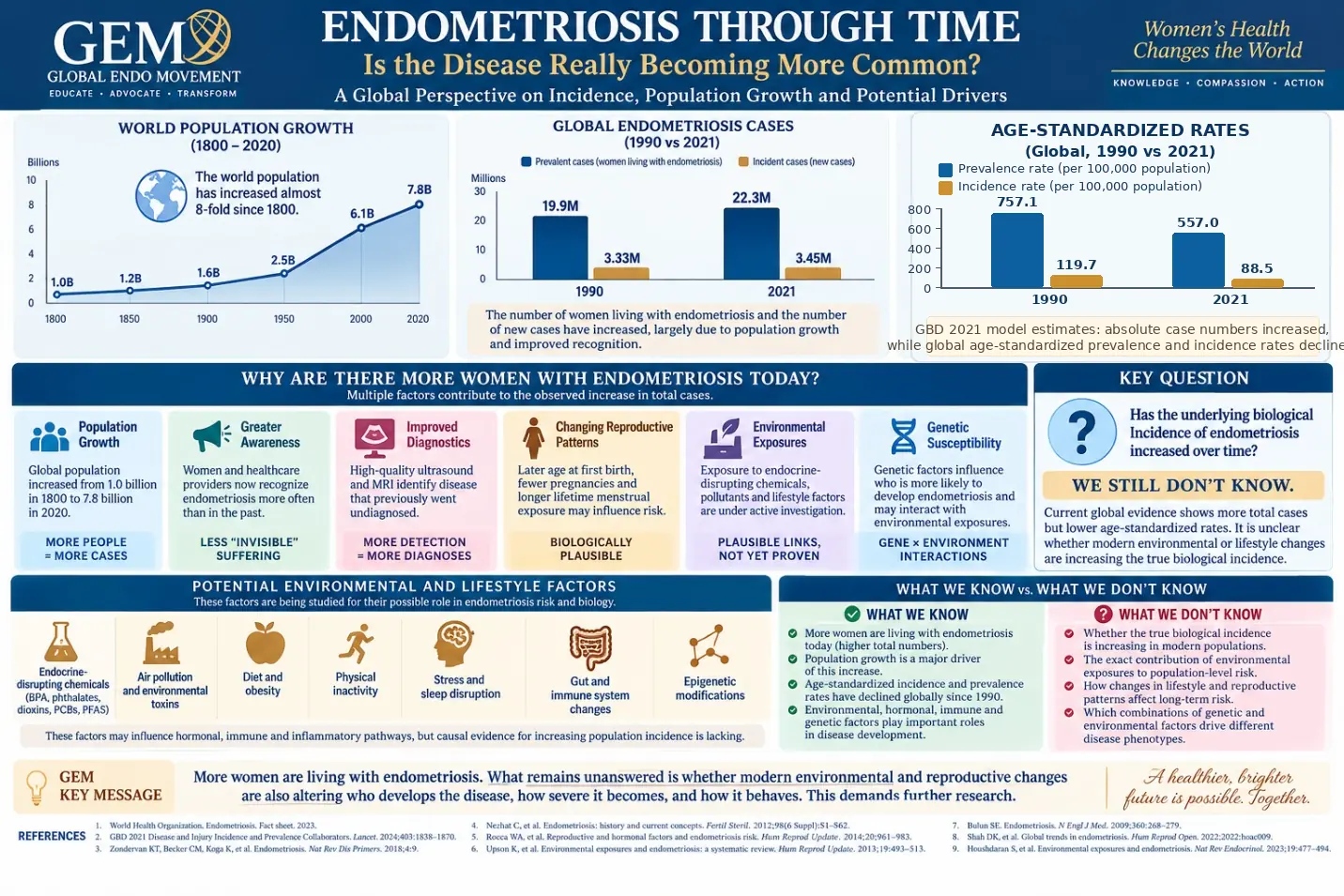
Infographic titled ENDOMETRIOSIS THROUGH TIME, Is the Disease Really Becoming More Common?, A Global Perspective on Incidence, Population Growth and Potential Drivers, with the GEM Global Endo Movement logo (Educate, Advocate, Transform) and the words Women's Health Changes the World (Knowledge, Compassion, Action). Three charts across the top. WORLD POPULATION GROWTH (1800 – 2020): a line chart in billions with points 1.0B in 1800, 1.2B in 1850, 1.6B in 1900, 2.5B in 1950, 6.1B in 2000 and 7.8B in 2020, labelled The world population has increased almost 8-fold since 1800. GLOBAL ENDOMETRIOSIS CASES (1990 vs 2021): a bar chart in millions of Prevalent cases (women living with endometriosis) 19.9M in 1990 and 22.3M in 2021, and Incident cases (new cases) 3.33M and 3.45M, captioned The number of women living with endometriosis and the number of new cases have increased, largely due to population growth and improved recognition. AGE-STANDARDIZED RATES (Global, 1990 vs 2021): a bar chart of Prevalence rate (per 100,000 population) 757.1 in 1990 and 557.0 in 2021 and Incidence rate (per 100,000 population) 119.7 and 88.5, captioned GBD 2021 model estimates: absolute case numbers increased, while global age-standardized prevalence and incidence rates decline, with the end of the caption cut off at the right edge. A band headed WHY ARE THERE MORE WOMEN WITH ENDOMETRIOSIS TODAY? Multiple factors contribute to the observed increase in total cases, with six cards: Population Growth (Global population increased from 1.0 billion in 1800 to 7.8 billion in 2020; MORE PEOPLE = MORE CASES); Greater Awareness (Women and healthcare providers now recognize endometriosis more often than in the past; LESS "INVISIBLE" SUFFERING); Improved Diagnostics (High-quality ultrasound and MRI identify disease that previously went undiagnosed; MORE DETECTION = MORE DIAGNOSES); Changing Reproductive Patterns (Later age at first birth, fewer pregnancies and longer lifetime menstrual exposure may influence risk; BIOLOGICALLY PLAUSIBLE); Environmental Exposures (Exposure to endocrine-disrupting chemicals, pollutants and lifestyle factors are under active investigation; PLAUSIBLE LINKS, NOT YET PROVEN); Genetic Susceptibility (Genetic factors influence who is more likely to develop endometriosis and may interact with environmental exposures; GENE × ENVIRONMENT INTERACTIONS). A KEY QUESTION box: Has the underlying biological Incidence of endometriosis increased over time? WE STILL DON'T KNOW. Current global evidence shows more total cases but lower age-standardized rates. It is unclear whether modern environmental or lifestyle changes are increasing the true biological incidence. A band headed POTENTIAL ENVIRONMENTAL AND LIFESTYLE FACTORS, These factors are being studied for their possible role in endometriosis risk and biology, with icons labelled Endocrine-disrupting chemicals (BPA, phthalates, dioxins, PCBs, PFAS), Air pollution and environmental toxins, Diet and obesity, Physical inactivity, Stress and sleep disruption, Gut and immune system changes, and Epigenetic modifications, and the line These factors may influence hormonal, immune and inflammatory pathways, but causal evidence for increasing population incidence is lacking. A panel headed WHAT WE KNOW vs. WHAT WE DON'T KNOW. WHAT WE KNOW: More women are living with endometriosis today (higher total numbers); Population growth is a major driver of this increase; Age-standardized incidence and prevalence rates have declined globally since 1990; Environmental, hormonal, immune and genetic factors play important roles in disease development. WHAT WE DON'T KNOW: Whether the true biological incidence is increasing in modern populations; The exact contribution of environmental exposures to population-level risk; How changes in lifestyle and reproductive patterns affect long-term risk; Which combinations of genetic and environmental factors drive different disease phenotypes. A GEM KEY MESSAGE bar: More women are living with endometriosis. What remains unanswered is whether modern environmental and reproductive changes are also altering who develops the disease, how severe it becomes, and how it behaves. This demands further research. A healthier, brighter future is possible. Together. A REFERENCES strip lists nine numbered citations: 1. World Health Organization. Endometriosis. Fact sheet. 2023. 2. GBD 2021 Disease and Injury Incidence and Prevalence Collaborators. Lancet. 2024;403:1838–1870. 3. Zondervan KT, Becker CM, Koga K, et al. Endometriosis. Nat Rev Dis Primers. 2018;4:9. 4. Nezhat C, et al. Endometriosis: history and current concepts. Fertil Steril. 2012;98(6 Suppl):S1–S62. 5. Rocca WA, et al. Reproductive and hormonal factors and endometriosis risk. Hum Reprod Update. 2014;20:961–983. 6. Upson K, et al. Environmental exposures and endometriosis: a systematic review. Hum Reprod Update. 2013;19:493–513. 7. Bulun SE. Endometriosis. N Engl J Med. 2009;360:268–279. 8. Shah DK, et al. Global trends in endometriosis. Hum Reprod Open. 2022;2022:hoac009. 9. Houshdaran S, et al. Environmental exposures and endometriosis. Nat Rev Endocrinol. 2023;19:477–494.

Open full size

Evidence & references

Endometriosis Through Time
Version 1.2 · Reviewed 13 September 2026

One source and an explicit population

Liu et al., Table 1: prevalent cases 19,869,195.64 to 22,275,015.21; incident cases 3,330,200.05 to 3,447,125.88 (1990 to 2021). Prevalence rates 757.10 to 556.98 and incidence rates 119.65 to 88.52 per 100,000. Methods specify female population; the prior all-population/both-sex interpretation was incorrect.

Model limits and comparison

The model's 95% uncertainty intervals are wide: prevalence about 13.59-27.69 million in 1990 and 15.52-30.41 million in 2021. These are not complete case counts. Age-standardized decline and increasing absolute counts do not by themselves establish biological incidence changes. WHO's approximately 190 million estimate uses a different framework; do not equate it with GBD.

Unchanged chart

The adjacent figure note clarifies the chart's abbreviated word population. Environmental/reproductive pathways in the image remain research hypotheses, not proof that they caused the modeled trend.

Full references

  • [RGBD] Liu F, Yuan S, Yan Q et al. Global Trends in Endometriosis Burden, 1990-2021: A Sociodemographic Analysis Using GBD 2021 Data and Projections to 2036. Int J Womens Health. 2026;18:560463. doi:10.2147/ijwh.s560463. PMID 41835846. Freely available
  • [RGBD2] Wang Z, Ouyang Y, Xue Z et al. Global, regional, and national burden and trends of endometriosis, 1990-2021: an analysis of the global burden of disease study 2021 and forecast to 2050. BMC Womens Health. 2025;25(1):519. doi:10.1186/s12905-025-04043-0. PMID 41152781. Freely available
  • [S13] WHO. Endometriosis. Fact sheet, 15 October 2025. Freely available
  • [R23084567] Nezhat C, Nezhat F, Nezhat C. Endometriosis: ancient disease, ancient treatments. Fertil Steril. 2012;98(6 Suppl):S1-62. doi:10.1016/j.fertnstert.2012.08.001. PMID 23084567. Freely available
  • [RESHRE] Becker CM, Bokor A, Heikinheimo O, et al. ESHRE guideline: endometriosis. Human Reproduction Open. 2022;2022(2):hoac009. doi:10.1093/hropen/hoac009. Freely available
  • [R33042729] Upson K. Environmental risk factors for endometriosis: A critical evaluation of studies and recommendations from the epidemiologic perspective. Curr Epidemiol Rep. 2020;7(3):149-170. doi:10.1007/s40471-020-00236-3. PMID 33042729. Freely available
  • [R32903210] Sirohi D, Al Ramadhani R, Knibbs LD. Environmental exposures to endocrine disrupting chemicals (EDCs) and their role in endometriosis: a systematic literature review. Rev Environ Health. 2021;36(1):101-115. doi:10.1515/reveh-2020-0046. PMID 32903210. Freely available

No listed institution endorses GEM.

Medical information

Do not delay care; seek emergency help for a suspected emergency.

Download PDF