

The History of Endometriosis
From Observation to Understanding
Why This History Matters
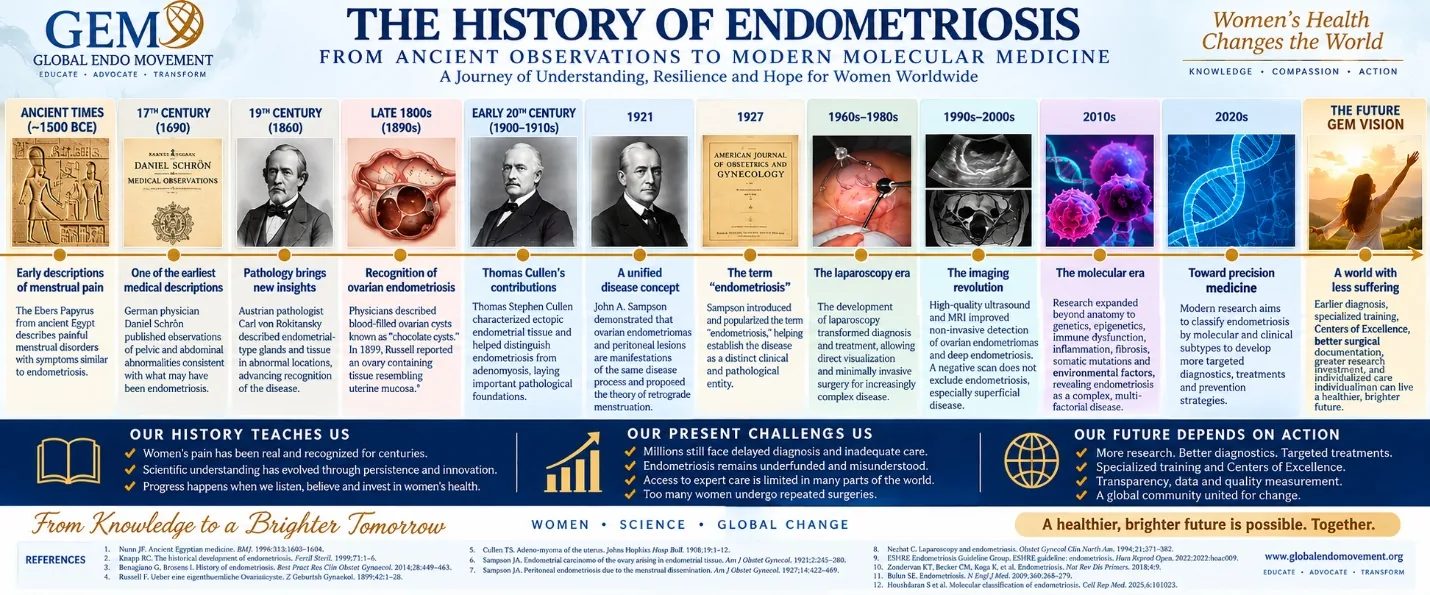
Historical texts describe pelvic or menstrual symptoms that some authors interpret as possible endometriosis. Symptoms alone cannot establish retrospective diagnoses. Modern understanding developed through pathology, surgery and imaging; genetics and precision-medicine approaches remain active research areas.
This history reminds us how far we have come – but also how much remains to be done. GEM believes that understanding the past should inspire a future of earlier diagnosis, expert treatment, greater transparency, stronger research, and better care for every woman affected by endometriosis.
Explore the journey below – from ancient observations to the future we are working together to create.
The Historical Journey at a Glance
Evidence & references
The History of Endometriosis
Version 1.1 · Reviewed 13 September 2026
Early history is disputed
Knapp interprets early-modern records as endometriosis descriptions; Benagiano and colleagues caution that symptoms alone cannot establish the disease. Ancient and early-modern entries must remain possible retrospective interpretations.
Pathological milestones
Rokitansky's 1860 work relates to uterine/myometrial pathology and adenomyosis history. Russell reported ovarian uterine mucosa in 1899; Cullen characterized ectopic mucosa. Sampson's 1921/1927 work shaped ovarian/peritoneal disease concepts; retrograde menstruation is not a complete modern explanation. Frankl named adenomyosis uteri in 1925.
Citation repair
The 1991 article's first author is Benagiano, followed by Brosens. Historical claims here rely on identified historical reviews, not an assertion that every original archival work was directly inspected.
Full references
- [R10428141] Knapp VJ. How old is endometriosis? Late 17th- and 18th-century European descriptions of the disease. Fertil Steril. 1999;72(1):10-14. doi:10.1016/s0015-0282(99)00196-x. PMID 10428141. Freely available
- [R24853333] Benagiano G, Brosens I, Lippi D. The history of endometriosis. Gynecol Obstet Invest. 2014;78(1):1-9. doi:10.1159/000358919. PMID 24853333. Freely available
- [R1761667] Benagiano G, Brosens I. The history of endometriosis: identifying the disease. Hum Reprod. 1991;6(7):963-968. doi:10.1093/oxfordjournals.humrep.a137470. PMID 1761667. Freely available
- [R16515887] Benagiano G, Brosens I. History of adenomyosis. Best Pract Res Clin Obstet Gynaecol. 2006;20(4):449-463. doi:10.1016/j.bpobgyn.2006.01.007. PMID 16515887. Freely available
- [R37116500] Heithoff DM, Barnes V L, Mahan SP et al. Re-evaluation of FDA-approved antibiotics with increased diagnostic accuracy for assessment of antimicrobial resistance. Cell Rep Med. 2023;4(5):101023. doi:10.1016/j.xcrm.2023.101023. PMID 37116500. Freely available
- [S01] ESHRE. Endometriosis guideline. 2022. Freely available
No listed institution endorses GEM.
Medical information
Do not delay care; seek emergency help for a suspected emergency.
This material is for educational purposes only and does not constitute medical advice or create a clinician-patient relationship with GEM.
© 2026 Global Endometriosis Movement. All rights reserved.