

Genes, Environment and Endometriosis
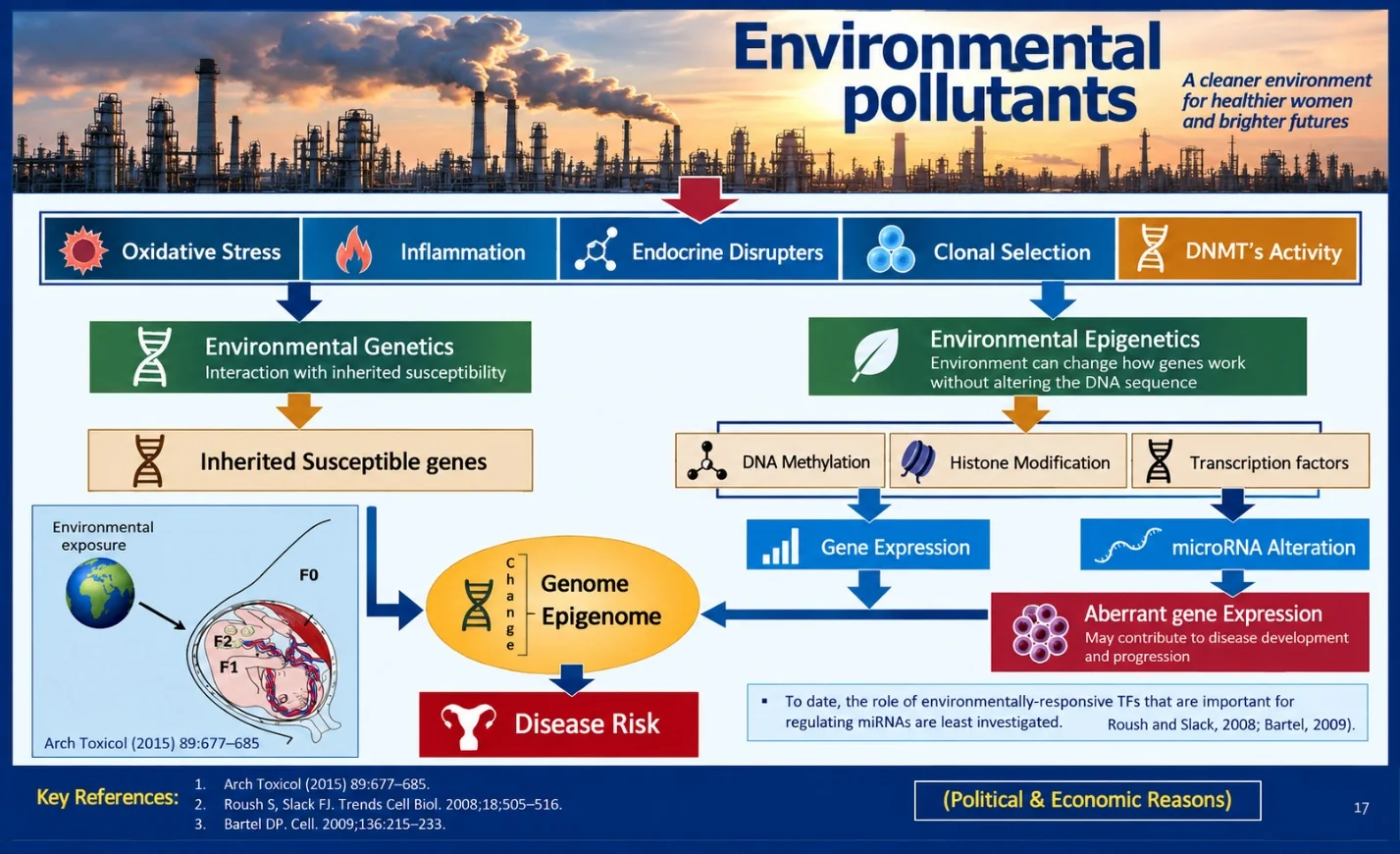
A simple explanation of why endometriosis may behave differently from one woman to another
The concept at a glance
Evidence & references
Genes, Environment & Endometriosis
Version 1.1 · Reviewed 13 September 2026
Genetic susceptibility
Rahmioglu et al. analyzed 60,674 cases and 701,926 controls and identified 42 loci with 49 distinct association signals. These associations support polygenic susceptibility, not a deterministic test for an individual.
Epigenetics and environment
The slide combines possible mechanisms; it is not a proven chronological causal chain. Observational exposure associations and epigenetic findings do not show why a particular person developed disease. The epigenetic review is a 2025 publication, online in 2024.
Founder observation and treatment
The Founder's geographic impressions are retained as attributed personal observations, not independently measured epidemiology. Hormones can suppress activity and symptoms; they do not surgically excise lesions. Genetic or environmental findings alone do not establish the diagnosis.
Full references
- [R36914876] Rahmioglu N, Mortlock S, Ghiasi M et al. The genetic basis of endometriosis and comorbidity with other pain and inflammatory conditions. Nat Genet. 2023;55(3):423-436. doi:10.1038/s41588-023-01323-z. PMID 36914876. Freely available
- [S01] ESHRE. Endometriosis guideline. 2022. Freely available
- [R32903210] Sirohi D, Al Ramadhani R, Knibbs LD. Environmental exposures to endocrine disrupting chemicals (EDCs) and their role in endometriosis: a systematic literature review. Rev Environ Health. 2021;36(1):101-115. doi:10.1515/reveh-2020-0046. PMID 32903210. Freely available
- [R35565013] Wieczorek K, Szczęsna D, Jurewicz J. Environmental Exposure to Non-Persistent Endocrine Disrupting Chemicals and Endometriosis: A Systematic Review. Int J Environ Res Public Health. 2022;19(9):5608. doi:10.3390/ijerph19095608. PMID 35565013. Freely available
- [R39625421] LE KN, Benor A, Decherney A. An update on epigenetic mechanisms in endometriosis. Minerva Obstet Gynecol. 2025;77(4):300-308. doi:10.23736/s2724-606x.24.05631-8. PMID 39625421. Freely available
- [R25667014] Wei J, Li F, Yang J et al. MicroRNAs as regulators of airborne pollution-induced lung inflammation and carcinogenesis. Arch Toxicol. 2015;89(5):677-685. doi:10.1007/s00204-015-1462-4. PMID 25667014. Freely available
- [R18774294] Roush S, Slack FJ. The let-7 family of microRNAs. Trends Cell Biol. 2008;18(10):505-516. doi:10.1016/j.tcb.2008.07.007. PMID 18774294. Freely available
- [R19167326] Bartel DP. MicroRNAs: target recognition and regulatory functions. Cell. 2009;136(2):215-233. doi:10.1016/j.cell.2009.01.002. PMID 19167326. Freely available
- [RTRANS] Heard E, Martienssen RA. Transgenerational epigenetic inheritance: myths and mechanisms. Cell. 2014;157(1):95-109. doi:10.1016/j.cell.2014.02.045. PMID 24679529. Freely available
No listed institution endorses GEM.
Medical information
Do not delay care; seek emergency help for a suspected emergency.
This material is for educational purposes only and does not constitute medical advice or create a clinician-patient relationship with GEM.
© 2026 Global Endometriosis Movement. All rights reserved.